
Exposities

ned / eng

 A duo exhibition by Jeannette Slütter and Harriet Rose Morley.

2026 marks the start of a residency period for a new exhibition curated by artists and former co-directors of Platform BK, Jeannette Slütter and Harriet Rose Morley. The artists will have the opportunity to create new artworks at Nieuwe Vide. The exhibition will also evolve over time. The central theme is aftercare; how do we care for each other, especially after major life events? This aligns with our four-year theme: Composting Politics.


Supporting Act(s)

Like a performance that relies on more than one voice, the exhibition comes to life through relationships—between what is shown, what is shared, and what is collectively practiced. Every act of presentation is shaped by what comes before it: the material conditions, negotiations, and forms of labour that accumulate over time.

Rather than presenting a single, static display,  Supporting Act(s) brings together different act(ion)s; through artworks, spatial structures, workshops, and conversations these interconnected elements give the exhibition shape. When support is understood as a shared, collective process—constructed, tested, and continually renegotiated—what does it mean to give support, to receive it, or to function as the supporting act itself?

Through tools, sculpture, and scenography, the practices of Slütter and Morley examine the material, social, and political conditions of support. Their work engages both formal systems—such as institutional frameworks, architectural structures, and sites of making—and informal networks of trust, responsibility, and collective organisation.

Across these acts, Supporting Act(s) reflects on the shifting roles we inhabit as artists, makers, collaborators, and advocates. Sculpture and scenography become ways of thinking through how we move within systems.

Shaped by friendship, collaboration, and shared advocacy, the exhibition foregrounds support as something enacted through participation, exchange, and evolving networks. Particular attention is given to moments of tension and rupture—when structures reveal their fragility, rules begin to falter, and collaboration opens up new possibilities for what systems can become.


More about the artists

Jeannette Slütter is a multidisciplinary artist exploring human-made systems both within and beyond the art world, with a particular focus on our relationship to architecture. Her work examines both explicit structures – rules, regulations, floor plans – and the subtle, unwritten norms that shape our behavior. She is interested in the power embedded in these systems. She looks at the gap between architectural representation and lived experience. Floor plans, elevations, and other spatial drawings suggest how a space is organized, but they reveal little about how it is actually inhabited. Many elements influence the complex ways people adapt, inhabit, and make decisions within a space. Through site-specific installations, she tells stories using performance, ceramics, glass, metal, photography, and video.

She studied at the Royal Academy of Art in the Hague and has received a Master’s degree from the Royal Academy of Fine Arts in Antwerp. She has collaborated with spaces such as, MORPHO, Glas – Museum of Glass Art in Denmark, Amsterdam Ferry Festival, and the Nieuwe Instituut in Rotterdam. In 2025, she co-designed the exhibition layout for the Dutch Pavilion at the International Architecture Exhibition, La Biennale di Venezia, in collaboration with Koos Breen.


Harriet Rose Morley is an artist based in The Hague (NL), originally from the UK. Her practice examines the gendered and labour politics embedded in the technical aspects of making across art, design, and architecture. She approaches practices such as metalwork, woodwork, and textile work not as nostalgic crafts, but as critical tools for exploring broader questions of labour, social relations, and material culture.

Her ongoing research project, Hard Work, Soft Work, investigates the intertwined dynamics of technical and relational labour within workshop-based environments. “Hard Work” refers to the technical skills exchanged through processes of making, while “Soft Work” foregrounds the often undervalued labour of communication, organisation, mediation, and solidarity that sustains collective working cultures and enables the transfer of knowledge.

Morley combines hands-on material research with an interest in social infrastructures, developing para-functional tools*, architectural objects, and forms of workwear that reflect on the workshop as a social and political site—one in which technical and social knowledge can be shared through equitable skill exchange and collective agency.

She studied Sculpture and Environmental Art at the Glasgow School of Art, completed an MA at the alternative art school The School of the Damned, and earned an MA from HKU University of the Arts Utrecht. From 2023 to 2025, she served as Co-Director of Platform BK, where she focused on the structural conditions shaping artistic and cultural labour. She was the 2022–2024 recipient of the Loughborough University Handicraft Commission and collaborates with artist Olga Micińska on the Building Institute, an educational platform aimed at strengthening diversity and equity within the blue-collar trades. In 2025, Morley was Technical Fellow at the Rijksakademie in Amsterdam, expanding her research into how material processes, institutional structures, and cooperative labour shape cultures of making.

*devices or tools used to help change habitual behaviour

Opening Saturday 7th of March 14:30 – 17:00 until Sunday 26th of April 2026.

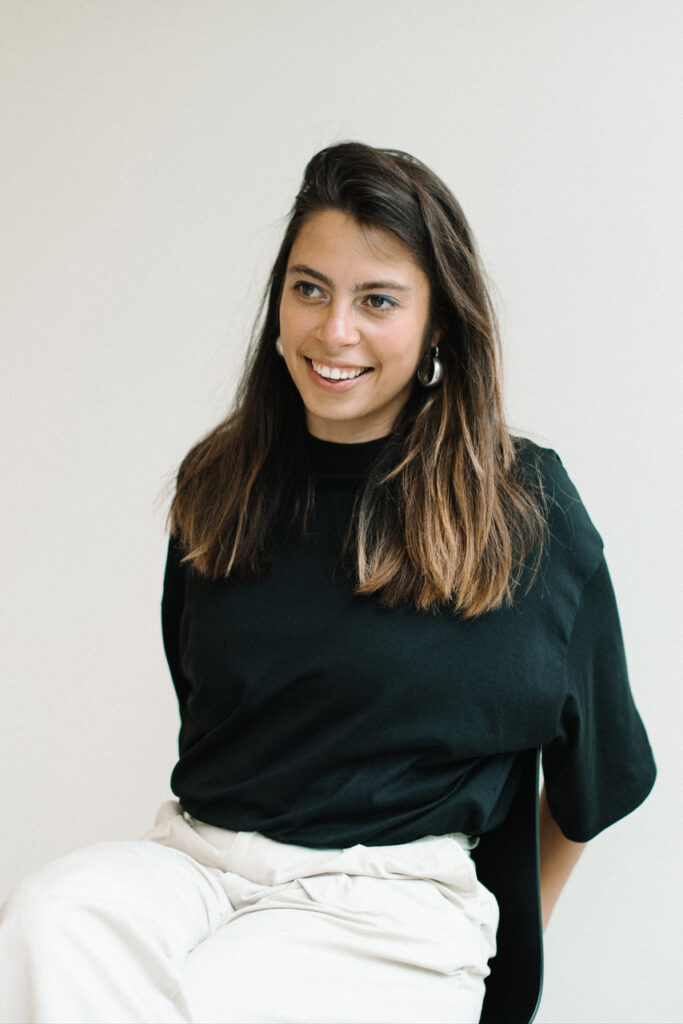
Jeannette Slütter

Harriet Rose Morley

12 Dec t/m 21 Dec 2020

Slappe Druiven Scherpe Randjes

04 Nov 2020

Tumult

10 Sep t/m 01 Nov 2020

No Hope for Sisyphus

07 Aug t/m 23 Aug 2020

TMI: searching for truth in the post-truth era

08 Jun t/m 01 Sep 2020

Unlocked/Reconnected

27 Apr t/m 23 May 2020

Verena Hahn

14 Feb t/m 08 Mar 2020

Ministerie van Tevredenheid

09 Jan t/m 09 Feb 2020

Not For Profit Art Party